Bachelor of Fine Art (Honours), UNSW Art & Design
By Miranda Collins
I’ve heard a rumour that some UNSW Honours students live in their studios. The rumour remains entirely unsubstantiated but in the depths of The Annual exhibition, I feel an uneasy sense of transgression as though accidentally intruding in someone’s private space. If the students have made the campus their home, I’m an uninvited guest.
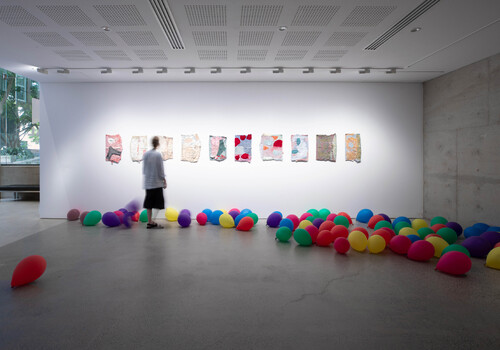
The Annual sprawls across UNSW Art & Design’s Paddington campus, but the BFA Honours artworks are in the UNSW Galleries in F block (beneath their studios). It’s the most professional space, so I immediately notice the balloons. There are hundreds of them strewn across the polished concrete floors—bright birthday party colours and so out of place in the white cube gallery with its atmosphere of serious legitimacy. There’s a slightly dusty, deflated look about them, a feeling of aftermath. I assume I’ve missed the opening. One of the staff notices me staring and explains that they’re actually an installation.

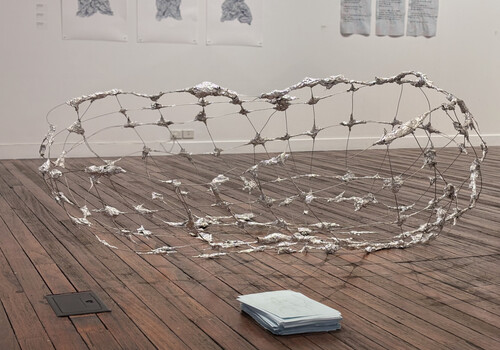
Jordan Dempsey, Untitled (Celebration), 2025, and Monika Cvitanović, Remediation series, 2022–25. Installation view: ‘The Annual 2025 Graduate Exhibition’, UNSW Galleries, Sydney, 2025. Photo: Jessica Maurer
UNSW Galleries isn’t unique with its banal white cube interior. We recognise contemporary art because we find it on featureless blank walls in these evenly lit rooms. Jordan Dempsey’s Untitled (Celebration) (2025) disrupts this aesthetic convention with balloons—familiar traces of everyday life that trouble the delineation between art and a pile of stuff. The space is no longer empty, neutral, or exclusive, but inhabited, domestic, and suburban. At the same time, the party is over. I’m only imagining some intimate gathering. I’m an outsider not a participant.
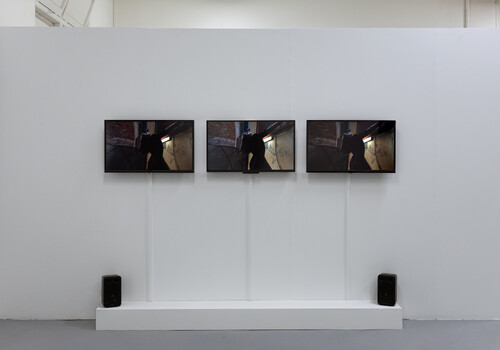
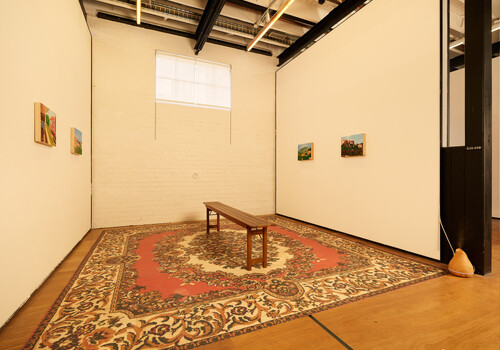
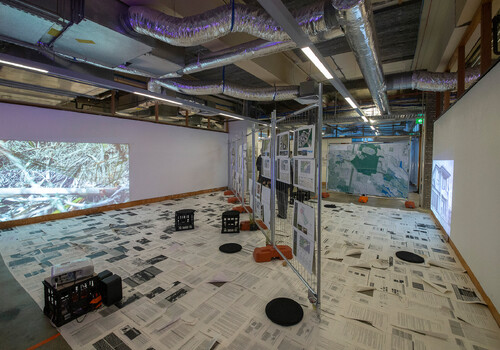
I weave my way through the gallery, apprehensive. In the final room, Izzy Page’s a communal return (2025) envelops a corner. On the floor, there are layers of Persian rugs. Above them, two videos depict careful, intimate vignettes: a cluttered kitchen, a heaving coat rack, and the soft glow of a TV. I hear snippets of conversations, the rustle of footsteps. I’m inside a house with its rhythms and routines but yet again, I’m estranged. The projections are long and narrow, akin to a slice of window between curtains or the gap under the door where the light leaks in. Page focuses on fragments: close-ups of objects, pieces of rooms, the inhabitants never fully in frame. I don’t know these people, but I have my own ideas about them. It’s like looking into the homes of strangers and seeing dioramas of their lives.

Izzy Page, a communal return, 2025. Installation view: ‘The Annual 2025 Graduate Exhibition’, UNSW Galleries, Sydney, 2025. Photo: Jessica Maurer
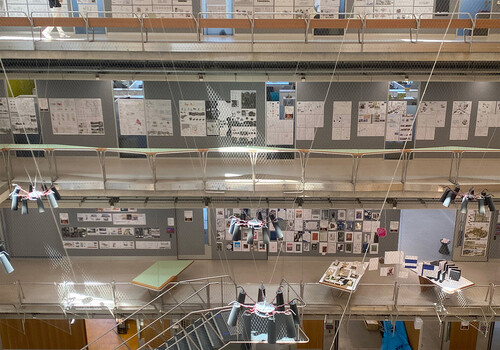
I retrace my steps and make my way upstairs, where I find Mei Lin Meyers’ Rhizome (fruit bag) (2025). A rhizome is a root, like ginger, that grows new branches when its nodules are split; it’s resourceful, adaptable, and resilient. Meyers says, “the way I think, use materials, and concepts is rhizomatic, it’s branching, expansive, and also non-linear.” Meyers’ rhizome is a half-digested collage of nearly-familiar fractals, and almost-things. There are soft sculptures, collages, paintings, and plastic crates. Everything is strung together with stripy string, shiny carabiners, and spiky anodised fidget rings. The same motifs are repeated but distorted, abstracted, and refracted: soft toys, pedestal fans, citrus fruit, chickens, and heaps of ginger, split and reconstituted, mirrored, repeated and reassembled. It’s deeply personal, like excavating the sedimentary layers accumulated in a stranger’s bedside drawers. It feels vulnerable. These are spilled guts, not made of blood and tissue but the history and memory encoded into everyday objects, raw and revenant.

Mei Lin Meyers, Rhizome (fruit bag), 2025. Installation view: ‘The Annual 2025 Graduate Exhibition’, UNSW Galleries, Sydney, 2025. Photo: Jessica Maurer
I don’t believe the artists deliberately position us as outsiders, but Dempsey, Page, and Meyers inadvertently fuel an appetite for trespassing. In the gallery, their intimate worlds are flayed and displayed for my consumption, fuelling an insuppressibly human urge to steal glimpses into private realms. There’s a small thrill in all this prying, accompanied by a twinge of guilt and a little shame—but that’s all part of the appeal.
Miranda Collins is a Gadigal-based artist and writer.