Bachelor of Fine Art, Monash Art, Design and Architecture
By Tilda Njoo
A bedroom secret nearly escapes, a meal is plated and forgotten fabric begins to mould at the MADA grad show. Textile-based works by Demitra Agouras, Mellyn Sun and Ashya James unveil scenes of domestic intimacy, where unacknowledged moments are lifted up to be examined.

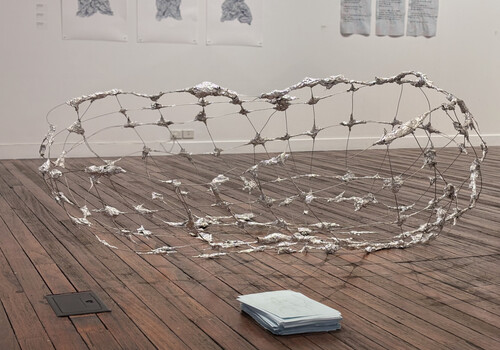
Demitra Agouras, Domestic Constellation, 2025, second hand lace, crochet, LED light, 116 x 220 x 170 cm. Monash University, Melbourne. Photo: Andrew Curtis.
Agouras’ Domestic Constellation gestures me into my first intimate encounter. Hidden in a small room behind a curtain, the installation comprises five unique lace panels hanging from the ceiling, mimicking a four-poster bed. In the middle of the “bedroom” created by the panels, perceptible only as your eye focuses beyond the lace threads, is a single exposed lightbulb. My gaze is hesitantly invited in by the naked bulb, shyly throwing its light about the room and leaving shadowy lace impressions on the walls. This moment of cautious intimacy (may I look inside?) is a domestic imaginary, suspended in air. I may enter the room but I may not breach the threshold of the lace boundaries, nor sully the shy glow inside with the full force of my gaze.

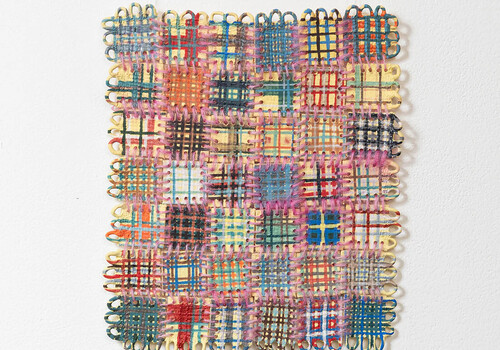
Mellyn Sun, 余, (left to right) (Abundance), 2025, acrylic on tablecloth fabric, wooden dining chair backing, 59 x 50.4 cm; 婆婆 (Portrait of my Grandma), 2025, acrylic on mdf board, 71 x 52 cm;香 (Fragrant), 2025, acrylic on tablecloth fabric, wooden dining chair backing, 59 x 50.4 cm. Monas University, Melbourne. Photo: Andrew Curtis.
Sun’s 香 (Fragrant) and 余 (Abundance) also mark domestic scenes of anticipation — this time existing not in the imagined intimacy of Agouras’ private room, but in the suspended moment between the serving and devouring of a home-cooked meal. Here, various foods are painted onto cloth placemats and mounted onto wicker-backed dining chairs. The steamed fish of 香 (Fragrant) eyeballs me lazily as I peer closer, and 余 (Abundance)’s plucked chicken lays out on its plate, head and all.
The paintings are humble, almost overshadowed by the bright sheen of the floral motif woven into the placemats, or their patterned-cloth borders. But they speak to nostalgic sentiments. The components of a shared meal — food, placemat, chair — are condensed into a single instance, bound tightly together. This gives the impression of a quiet intensity; of desire rising and a meal on the precipice. Sun revels in this domestic anticipation, bringing reverence to moments neglected. Mothers and grandmothers labouring over a dinner plate to present a meal that not only nourishes, but that looks exquisite. This attention to detail and beauty exists briefly, until the moment is shattered and the meal is devoured.

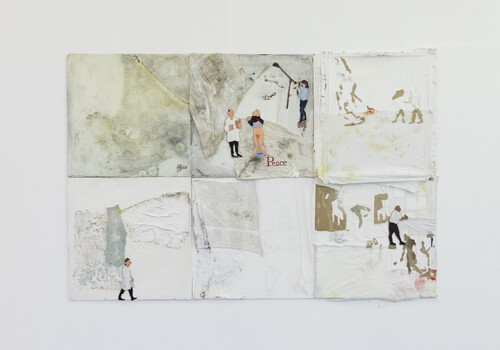
Ashya James, Consultation, 2025, oil, pastel, collage on board, 60 x 60 cm. Monash University, Melbourne. Photo: Andrew Curtis.
Attuned to Agouras’ and Sun’s use of textiles, Ashya James’ Consultation catches my eye. Is that lace I see, adorning these painting-cum-collages? No, looking closer, I see fabric — towels, cotton, bandages — pasted onto board and then painted over in white, giving the impression of a sheer, patterned lace. Delicate textiles are draped across the boards, bunching and gathering in corners, crinkled from time spent shoved into a linen cupboard. James painstakingly creates this assemblage of clean white fabrics and then! – dirties it. Painted over and drawn onto with greens and blues, they appear bruised and worn. The towels look wet and mouldy, as if they have been left, unloved, to the elements. Taking cues from the title of the work, I read Consultation as commentary on the raw, bodily messiness which inevitably sullies crisp hospital bedding and bandages, where the clinical recedes and the grime seeps in. A consideration of the discomfort of being a medicalised subject, perhaps. However, for me, it is Consultation’s evocation of a domestic threshold — here between “clean” and “dirty” fabric — which resonates across Agouras’ lace membrane and Sun’s placemats.
Agouras, Sun and James lift the curtain on the secret interstices obscured between domestic moments. The artists do not wrap me up in their fabric worlds, but rather, brush me as I walk past, inviting me to turn around, look back, and witness their intimacy.
Tilda Njoo is a writer from Naarm/Melbourne.