Photography, Victorian College of the Arts
By Erin Barwood
Photographs can be portals. In the hands of the right artist, a camera is a magical instrument that captures the fleeting nature of memory and time, taking us back to lost moments or moving us somewhere completely new. Many photographers at the VCA this year embraced sculptural qualities in their work, allowing for an immersive experience. For me, Felix Oliver, Sam Jones and Camille Robinson’s work called up the world of dreams and the unconscious, and the tangible qualities of each transported me into these other realities.

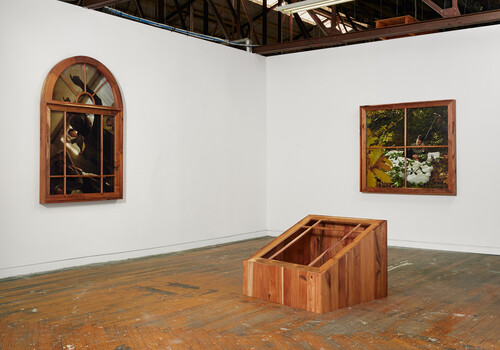
Installation view of Felix Oliver, Cicada Trails (1-3), 2025, artist-made blackwood frames, inkjet prints, non-reflective glass, acrylic, Victorian College of the Arts, Melbourne. Photo: Lucy Foster
The unique blackwood frames of Felix Oliver’s Cicada Trails (1-3), hand-made by the artist, transform his series of inkjet prints into scenes unfolding from behind windows. One frame protrudes from the ground, and the image of a winding staircase that it holds seems to continue down through the gallery’s floor. A miniature window carved into its left side is small enough for a doll’s house. The other two frames in the series hang on the wall, entrancing me with their dynamic and intimate compositions of people congregating and resting in private spaces. Each window-shaped frame elicits a sort of nostalgic voyeurism; rather than spying on the people and places photographed, I felt I was gazing at them curiously, even wistfully. Muted, cozy lighting make the photographs appear sleepy, like they have been plucked from the edge of a dream.

Installation view of Sam Jones, Feast (1-6), 2025, c-type print, board, inkjet print, tape, Victorian College of the Arts, Melbourne. Photo: Christo Crocker
The central piece in Sam Jones’s series, Feast (1-6), stands taller than myself, inviting me into its fourth-wall-breaking folds. Side-by-side, supported by boards, the two largest prints cleverly subvert the still-life, a banquet imagined from afar. The zoomed-out perspective makes the feast one part of the subject rather than the whole. Instead, the artist considers the set-up of a still-life in a photography studio. As such, they feel like a tear in reality that I can step into rather than a static photograph, as if the still-life is waiting there for me to cross over and approach it. The unframedness of the series allows the edges to dissolve, enhancing the reverie-like quality of the work. Across the remaining prints, harsh cropping, digital manipulation (in one, a pineapple floats over a tennis court) and paper printouts of a cartoon man shaving his face add up to an absurdity evocative of piecing together a half-forgotten dream.

Installation view of Camille Robinson, L-R After Waking Up (Gilbert and George), Flight School (Gilbert and George), 2025, inkjet print, acrylic on paper, black frames, Victorian College of the Arts, Melbourne. Photo: Astrid Mulder
Camille Robinson’s Flight School (Gilbert and George), After Waking Up (Gilbert and George) and Stand Up (Gilbert and George) are three works made up of sixteen, thirty and fifteen frames respectively, stacked together in grid formations. Their scale and shape are reminiscent of billboards, suggesting themes of commercialisation. A pastiche of celebrity art duo Gilbert & George, Robinson’s compositions also draw on other familiar images and cultural references: Fiji water, Jeff Koons’s Balloon Dogs, Andy Warhol’s Banana (1967). Images of bottles repeat across the three works, as do the models who have posed for Robinson. Rippled grooves give the prints texture and weight, which, intended or not, I enjoyed tracing with my eyes. The vibrancy and humour of Robinson’s work is accompanied by the unsettling presence of loitering clouds of haunting black and white faces and pluming flowers. These severed heads are lit from beneath, like phantoms that remind us of the darkness lurking in the unconscious.
Through the camera lens, we can see the world in a way the human eye cannot. Each in their own way, Oliver, Jones and Robinson use careful consideration of the physical characteristics and displays of their photographs to transport the viewer into parallel worlds of memory, reverie and dream.
Erin Barwood is an emerging writer in Naarm/Melbourne. She completed her Bachelor of Art History and Curating at Monash University this year.