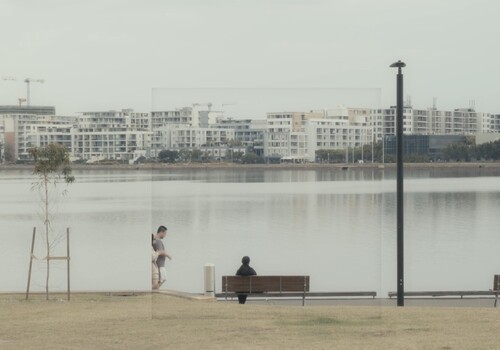
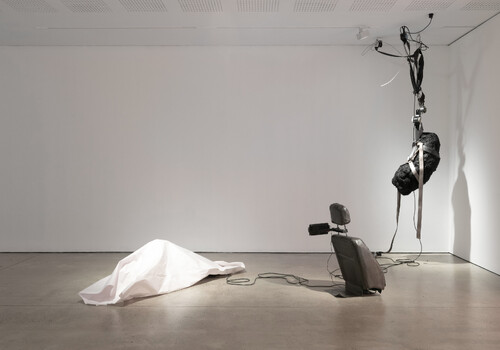
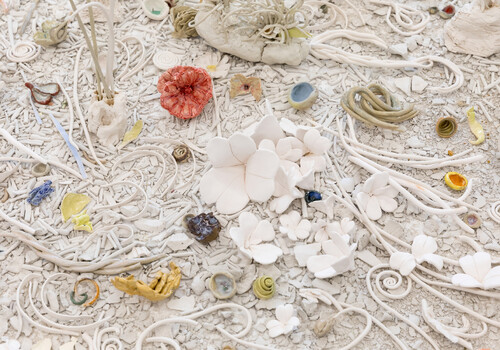
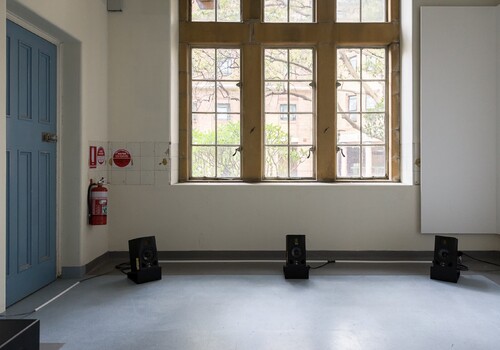
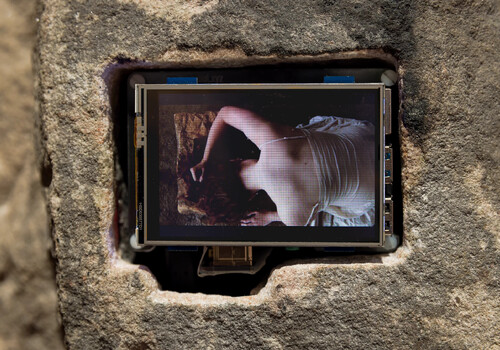
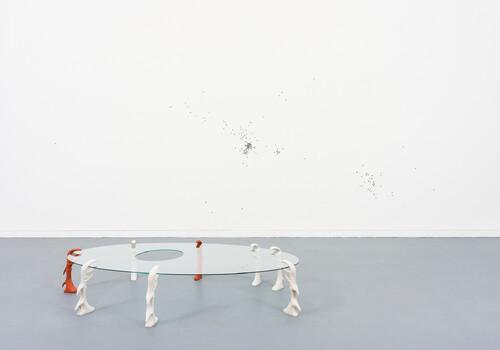
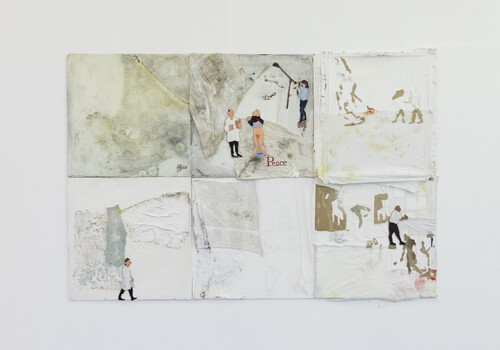
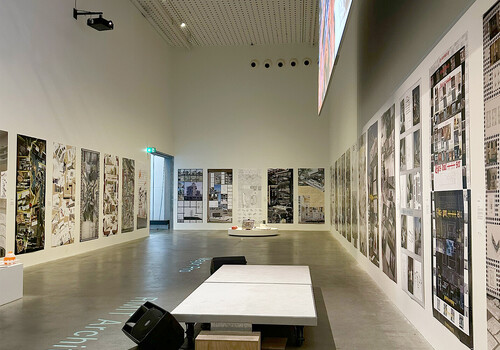
Sculpture, Bachelor of Visual Arts, Sydney College of the Arts
By Mei Lin Meyers
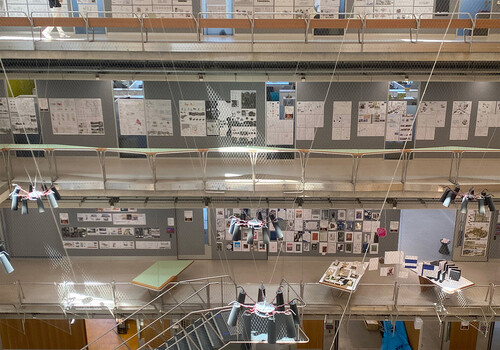
Black bird netting forms a semi-permeable canopy above the courtyard of the Old Teachers’ College (turned Sydney College of the Arts campus). It is a faux sky that stretches from roof to roof, cradling the foliage of palm trees. I am perplexed by the architecture but in love with the thrifty ways in which students carve out spaces for social connection.

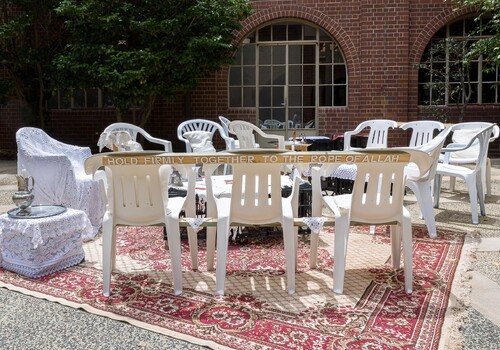
Ayşenur Kara, And hold firmly together to the rope of Allah (our third space), 2025, installation. Photo: Document Photography.
I stand beneath the netting, amongst Ayşenur Kara’s installation, And hold firmly together to the rope of Allah (our third space) (2025). At first, I assumed Kara’s installation was the permanent student lounge— white plastic chairs with makeshift side tables, blue gazebos dressed with Turkish rugs and milk crate shelves and tables. I often hear people lament about the lack of “third spaces” in Sydney, the quest for a space that is neither home nor work. Kara reminds us, these social spaces are not discovered, but made and furnished by community. The modification of cheap furniture and found materials is a reminder of the Pro-Palestinian encampment on the Quad Lawn in 2024, when students demanded the University of Sydney cut ties with the terror state of Israel. USYD eventually cracked down on the protests, calling these makeshift structures “obstructions to campus.”

Tom Band, the complete life & times of, 2025. Photo: Document Photography.
Tom Band’s cardboard dome, the complete life & times of (2025), could be considered a one-person tent, if that one person was sitting upright on a small stool. The artist’s bare feet poke out from the bottom of this claustro-cosy sculpture. Signage invites me to pop a gift through the slot titled “in” (I gift a Chinese Acupressure Ring) and in exchange, I receive a glossy, glitchy A5 song-lyric-zine accompanied by a CD. As an Autistic person, I appreciate Band’s scripted interaction. At home, I hook up my portable CD player to my laptop. I listen to the thirty-minute album five times through. The songs, performed by Band and SCA peers, Conner Chen and Lily Tsuruko Tucke, drift between aggressively noisy and softly angelic. I catch on to the lyric “tertiary vegetation”—a reference to the courtyard perhaps?

Lara-Marie Wilkinson, Porous Sufferance, 2025, multi-media collage. Photo: Document Photography
During the media preview, I catch up with the tour group as Lara-Marie Wilkinson is providing an artist talk for Porous Sufferance (2025). The fuchsia triptych of digital photo collages on plywood is a cacophony of wings and bugs manipulated together with images of the artist’s body. Reworking Julia Kristeva’s concept of abjection, Wilkinson talks of “infecting” the space with her chronic pain. Across the plywood and white gallery wall, vinyl stickers of ants eating apples, slug-like creatures, and bees, puncture the rectangular architecture. Rabbit, goat, and deer hide partially frame and cushion the glistening biomorphic photography. As the crowd dissipates, I am drawn to the rhythmic beating and cracking that echoes through the gallery space. Working alongside her disenfranchised ancestors, Wilkinson references Mauritian Sega—music and dance used as a mode of resistance against dehumanization—which is characterised by the drumming of the goatskin-clad ravanne instrument. The artwork’s positioning amongst the sullen cabinets of taxidermy birds lining the hallways of the Old Teacher’s College reminded me of the bird netting in the courtyard. I think of how certain bodies are abjected and excluded by the very structure of colonial institutions.

Ayşenur Kara, Hands, Heart and Tongue (1-3), A2 halftone screen prints, Graffiti tunnel USYD, 2025. Photo: courtesy of the artist.
As I leave through the USYD Graffiti Tunnel, I am drawn to Kara’s Hands, Heart and Tongue (2025) amongst the colourful noise. Beneath an A2 screenprint of martyred Palestinian journalist Shireen Abu Akleh are the words “JUSTICE THROUGH YOUR TONGUE” (in Arabic and English).
Through fashioning makeshift interventions, and pumping the gallery with cathartic music, the 2025 SCA cohort offer numerous illicit “obstructions to campus.” The students reminded me that resistance is everywhere—that despite university crackdowns on freedom of speech across so-called Australia—students continue to carve out spaces for community, connection, and expression.
Mei Lin Meyers 美林 is an emerging artist and writer based on Wangal Country. He is currently wrapping up his Bachelor of Fine Arts (Honours) at UNSW Art and Design.