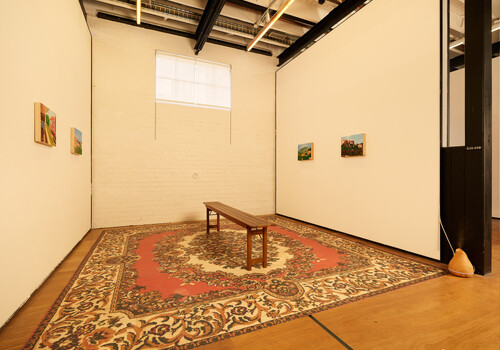
Painting, Victorian College of the Arts
By Alexandra Banning-Taylor
I like when a painting challenges me—when it lures me in with swatches of colour, abstract forms and spatial orientations that require careful contemplation. VCA’s Graduate Show included the artwork of Soyo Paek, Jess Chow and Alice Sabouraud, three artists from the third year painting department. I was allured by each artists’ distinct abstractions and interweaving figurative elements. I could not immediately cling to a form or associative feeling; instead, shadows, shapes and space unveiled themselves to me slowly. It felt like a dance, yet I was the only one moving: stepping back and forth, departing and returning with repeated double-takes, before finally walking away.

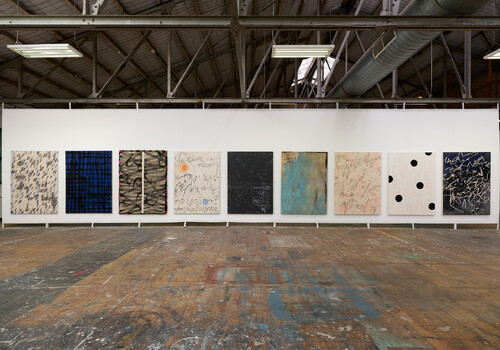
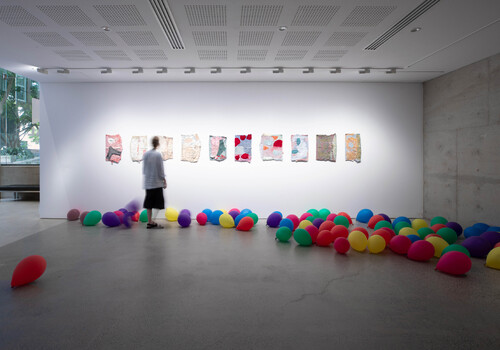
Soyo Paek, Emergence, 2025, Mixed-media, Dimensions unknown, Victorian College of the Arts, Melbourne. Image courtesy of the University of Melbourne. Photo: Christo Crocker.
Turning the corner into the first floor of the painting department, Soyo Paek’s Emergence (2025) captivated me. Stepping back, I was transfixed by the large, single row of nine mixed-media canvases. While uniform in size, they vary in their use of subdued tones and abstracted forms. Paek creates a visual language through contrasting soft, sharp and curving strokes with ambiguous, stencilled letters and cursive writing. This interplay reminded me of the spiritualistic automatic writing used by the twentieth-century artist, Hilma af Klint. While it is unclear whether Paek’s practice is a spiritually-infused one, it is nonetheless as striking in its expressive qualities. An encompassing formal technique in all nine paintings is the layering of various and opposing marks. When viewed in the direction from left-to-right, this technique is readily demonstrated in the third canvas: wide swooshes of black-strokes dominate the lighter, curved lines. My eyes come to a stop in the middle, this white and stable line contrasting the rhythm of movement on either side.

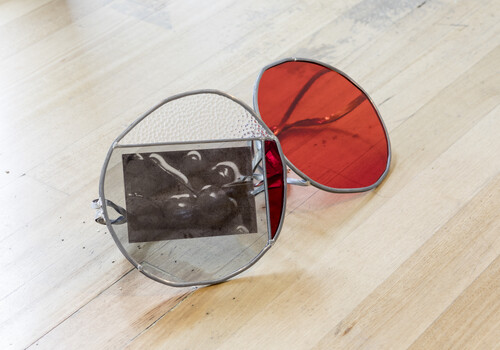
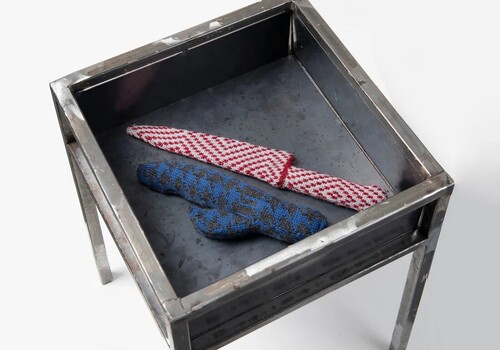
Jess Chow, Some things that reminds me of you, Silk, steel, pigments, glass and paper, dimensions unknown, Victorian College of the Arts, Melbourne. Image courtesy of the University of Melbourne. Photo: Astrid Mulder.
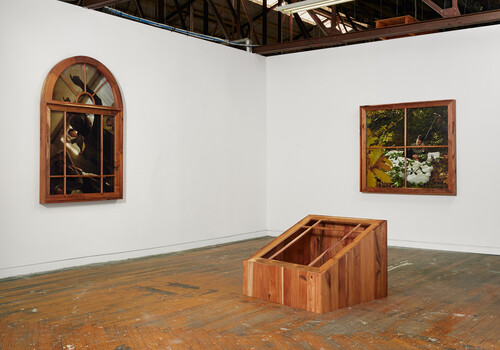
Walking into the next gallery room, Jess Chow’s two paintings, Some things that reminds me of you (2025), hang alone on the right side of the large wall. An installation also including a floor sculpture, Chow’s work draws me into the other world it coyly suggests. The pigments on silk organza hint at an expanded painting practice, one that leaves an alluring, glowing effect. The artwork on the left possesses a feeling of reverberating sound; its subject matter appears like a sci-fi, surrealist landscape into which I want to submerge my hand. Both paintings employ illusion and depth by the layering of shapes of varying hues, including a light, chartreuse colour. Geometric shapes, including white ovals, are outlined in grey and positioned within three columns, giving the impression of a topographical mountain scape. The accompanying painting to the right depicts an abstracted figure—one rendered as an elongated star shape in subdued red. This figure stands on a plinth and is replete with a transparent, oyster-shaded head that doubles as a halo. Chow’s works feel deceptive; the softness of colour and the sheer, gentle silk juxtaposes with strong steel frames, reinforcing the impression of a portal to an unknown dimension.

Alice Sabouraud, Boxing Fight, 2025, Oil on canvas, Dimensions unknown, Victorian College of the Arts, Melbourne. Image courtesy of the University of Melbourne. Photo: Astrid Mulder.
Walking further into the gallery space, I encounter Alice Sabouraud’s five oil paintings of varying width sizes. Each depicts an unusual conglomerate of bodies that appear superimposed onto one another. Initially, from afar, the strobe-light pink hue of intertwining forms and shapes render an abstracted exploration of colour. The ambiguous paintings of ripples, curves, shadows and shapes are beautifully executed and contrast with the works’ uncertain subject matter. Sabouraud’s only figurative element is a formally dressed man, turning in the corner of the first canvas to the far left side. Cumulatively, the forms appear alien-like and as though they are in a battle with one another—a conflict playing out across the canvases. I was working hard, transfixed by the strong sense of movement in the painting. As I move closer, eyes darting and forehead frowning, I reach the title, Boxing Fight (2025).
Abstract artworks can be deceptively simple and often the target of criticism, mainly for their technical execution. However, abstraction can also unveil meaning or purpose slowly—the mind can wander without a subject to grasp and make quiet, liminal associations. I was strangely threatened by what these works contained, but they were exactly what my mind needed in a world of endless images: contemplation.
Alexandra Banning-Taylor lives, writes and studies in Naarm/Melbourne. She is entering her fourth year of a double Bachelor of Art History and Curating, and Arts (French) at Monash University.