Bachelor of Fine Art, Master of Fine Art, UNSW Art & Design
By Maeve Sullivan
I’ve caught you red-handed—neck craned, thumbs twiddling, primed to scroll. Don’t worry, I’m writing this review in the same compromised position: shoulders hunched and eyes glued to the screen, the requisite posture of a writer, Substack reader and student in the age of AI. There’s no escaping it: we are being continually sculpted and transformed, in both mind and body, by the screens that surround us. I’m reminded of this as I walk into the “Black-Box”, a dedicated room at UNSW Art & Design’s The Annual for digital works. At first seduced by the space’s block-out curtains and bright displays, it is thanks to the works by graduating students Jade Xuan, Sophie McKay, and Rui (Rose) He that my attention is drawn to the broader implications of our digital enclosure.

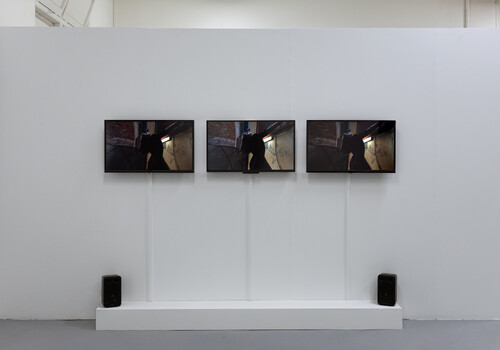
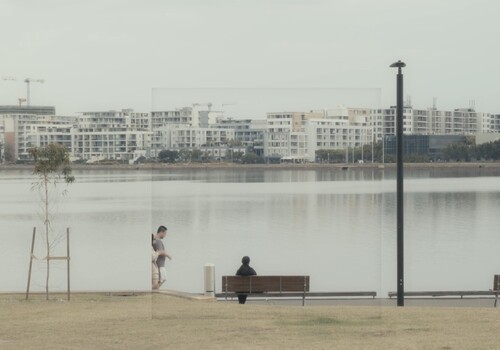
Jade Xuan, Through Time, 2025, 3-channel video installation on fabric, 2 minutes, looped. Photo: Courtesy of the University of New South Wales Art & Design.
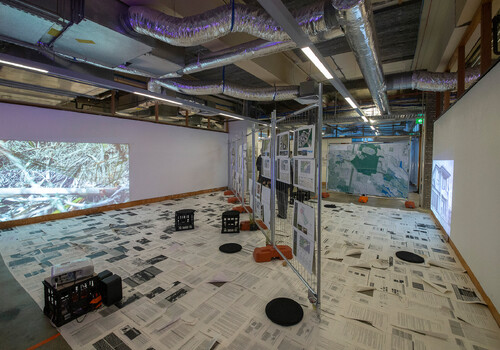
Endless Instagram reels have conditioned our viewing habits and attention spans, so it’s no surprise that, in the Black-Box’s darkness, I find myself entranced by Jade Xuan’s Through Time (2025), a three-channel video installation that satisfies our obsession with switching between multitudes of videos, images, and stories. In one video, a woman perches on a bench overlooking water; in another, two figures share a seat at Sydney Harbour; and in the third, a woman treads through the bush. Time slows into serenity, only to be unsettled by a frame-within-the-frame that either blocks passersby from view or renders them invisible until they enter. Like a phone screen imposed on the natural environment, the work makes me question how narrow our vision has become and what is excised by its pocket-sized dimensions. But it also promises a quick hit of calm—an irony I’m acutely aware of. The calm endures if viewers, reminded of their own digital voyeurism, surrender for more than thirty seconds.

Sally McKay, AI Companion Sophie, 2025, digitally embodied artificial intelligence. Photo: Courtesy of the University of New South Wales Art & Design.
“Say hello to Sophie!” reads a label beside a microphone and keyboard, inviting visitors to engage with Sally McKay’s life-sized AI Companion (2025). This work was created to support the Huntington’s disease community through the sharing of brain health knowledge. This purpose, however, is threatened by its form: digital companions—even in denim shorts and sneakers—can unnerve. In the space of an art exhibition, this tool of care risks becoming a novelty. But isn’t this, after all, precisely the purpose of art in university settings—to speak to humanity, stir emotion, and generate knowledge? Is AI art always destined to remain an uncanny aesthetic in the gallery, or can the university context of research redeem it? Artificial intelligence may yet become a graduate-show staple.

Rui (Rose) He, Loop: Replaying Your Fate Inside, 2025, acrylic, mirror, wood, plastic model hand, miniature figures, 3D-printed PLA, and LED lights. Photo: Courtesy of the University of New South Wales Art & Design.
Seeking something grounded, I find relief in Rui (Rose) He’s object-based sculpture Loop: Replaying Your Fate Inside (2025), which sits between Xuan’s and McKay’s work. I wonder how many others will pass it by, drawn more to the digital works surrounding it. But the relief is short-lived: Loop consists of three handheld infinity-mirror boxes stacked together. A sculpted hand sprawled on top seems to beckon me, yet instead of lifting me, it drags me down, like Alice tumbling into an algorithmically-coded rabbit hole. Below, a miniature city stretches into an endless corridor, and at the bottom, a bare passage dotted with minuscule figures offers space for contemplation: a vista of abandoned emptiness, a loss of the real?
Crawling out of the cyberswamp, as the cyberfeminist collective VNS Matrix put it in 1991, I have mixed feelings about the technologies increasingly infiltrating both our daily lives (and graduation exhibitions). I hold my phone in one hand, my notebook in the other. The best strategy, at this point, seems to be to keep one foot in the digital realm and the other firmly in the earthly.
Maeve Sullivan is a writer from Gadigal/Sydney. She is in her final year studying Art History and English at the University of Sydney.