






Melbourne School of Design (Architecture), The University of Melbourne
By Lachlan Hartnett
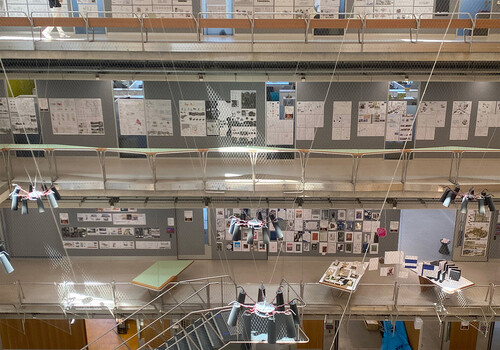
“Celebrate the future of design” is the subtitle of the 2025 MSDx Summer showcase, appearing on both wayfinding panels scattered throughout the Glyn Davis Building and the broader university campus, foregrounding the exhibition’s future-oriented student work. As an outsider to this institution (perhaps an interloper), I wanted to imagine the exhibition through the lens of a student enrolled at the Melbourne School of Design. Fittingly, the exhibition has been curated in a way that allows such a lens to be applied, with Bachelor of Design work being displayed across the top two levels of the building, and with Master of Architecture work displayed below.

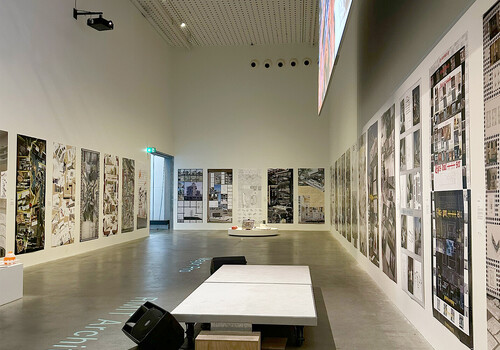
Glyn Davis Building Atrium Interior. Photo: Lachlan Hartnett.

Architectural Technologies 2: Analyse, led by Dr Sofia Colabella. Photo: Lachlan Hartnett.
On show for the subject Architectural Technologies 2: Analyse, led by Dr Sofia Colabella, is an overwhelming array of rich detail drawings, material, and component schedules packaged neatly across one hundred and twenty-two A4 panels. Tethered to the coursework agenda, the panels document and explore the idea of construction as a strategic process regarding structural systems and building services on an existing project. There is an intense level of specificity and rigour regarding Australian Standards and the National Construction Code (NCC) in the staging of the construction and documentation displayed, as seen in the work of students such as Alyssa Minkin. Ultimately, this course sets up the apparatus that these students must engage with in practice.

Alyssa Minkin in Architectural Technologies 2: Analyse, led by Dr Sofia Colabella. Photo: Lachlan Hartnett.
Due to its location on the top level of the Glyn Davis, and after having descended to each subsequent level, it became curious to note the level of power these more technical subjects hold over the other coursework on show. An omnipresent power that hovers both physically and non-physically over the work exhibited below. Design Studios often appeared to be confined to the realities of an existing regulatory system for architecture and construction. And it was here that I came back to the original subtitle of the exhibition: “Celebrate the future of design”. This future appears reluctant to implement drastic or radical change to this regulatory framework—something architects and designers can influence. We must recognise that this framework can change and is not an immutable moral system.

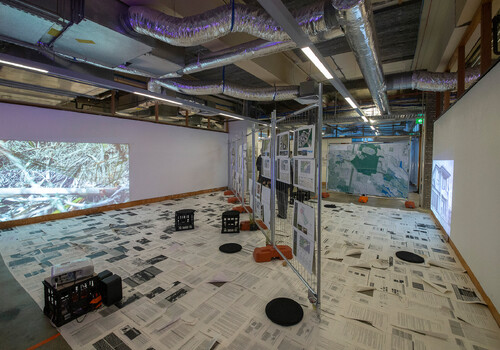
Studio 08: Open: Worldbuilding led by Laura Mártires. Photo: Lachlan Hartnett.
These thoughts brought me to Level 1, specifically to the Design Thesis Studio 08: Open: Worldbuilding, led by Laura Mártires, which appeared in a selection of Design Studios that sit in opposition to this professional stasis. Students were supported to envision a ficto-critical set of worlds for an architecture that isn’t yet constructed or even imagined. Here, narrative conjures new paradigms for the built environment. This can be seen in Bethany Tewes’ project, The Battery of the Nation, situated within the erasure of Tasmania’s coasts by rising sea levels. The project does not take on a reparative role in healing or mitigating such destruction, but rather seeks to reimagine the language of dwelling during coastal collapse. Thus, through the project, one can recognise that our existing systems of living are not suitable nor will be suitable in our imminent future. Here, Tewes enacts a new form of habitation through a radical repositioning of the extractivist utility of hydro-industrial architectures towards a civic gesture of dwelling.

Bethany Tewes, The Battery of the Nation, 2025. Photo: Lachlan Hartnett.

Bethany Tewes, The Battery of the Nation, 2025. Photo: Lachlan Hartnett.
One gets the sense that the act of world-making emancipated students from a more traditional approach to architectural communication and presentation. Such a notion is heightened by each world’s use of colour and composition, in contrast to the clean, pristine drawings of their neighbouring design studios. Yet, due to the diversity of each student-envisioned world, the overall studio display is perceived as inconsistent. Individual work seems to be pinned up by each student in isolation and without explicit acknowledgement of their peers. What sits between each world is a grey void, a no man’s land demarking the borders between each realm’s narrative. There is a point to this: the Design Studio argues for the curation of “a critical exhibition of each project.” Yet, I remain interested in what could sit between these worlds, their possible bridges, and what other futures could’ve been brought to light.
Having left the Glyn Davis Building, I thought again about this “future of design”. From courses and studios that incorporate Australian Standards and the NCC, the profession seems to be in safe hands, but having observed outliers who speculate with risk and radicalism, I can also see an additional future far beyond safety.
Lachlan Hartnett is a Master of Architecture student and a graduate of the Bachelor of Architectural Design program at RMIT University based in Naarm. He has exhibited work within Australia and internationally, most notably as a finalist within the 2023 Victorian Premier’s Design Awards and at the 2024 London Festival of Architecture.